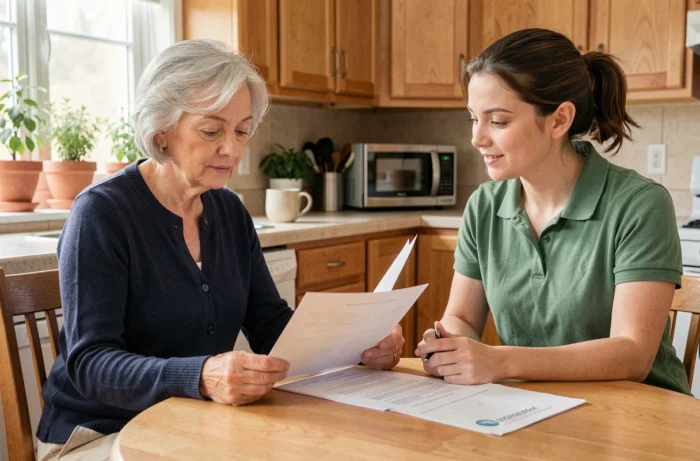
A parent who calls three times a week to check that their mother has taken her medication, a neighbor asked to drive a retiree to the doctor, a half-empty fridge because groceries are becoming too heavy to carry: these situations fill the daily lives of thousands of families. Solutions exist, but they often remain scattered among several contacts, multiple forms, and various deadlines.
Merging Home Services into Mixed SAD: What It Means for Families
Until recently, a senior needing both housekeeping assistance and home nursing care had to deal with two distinct organizations: the SAAD for daily help, and the SSIAD for care. Two schedules, two contacts, two administrative files.
The reform resulting from the 2022 social security funding law, reinforced by the law of April 8, 2024, on aging well, organizes the gradual merging of these structures into mixed home autonomy services (SAD). The goal is straightforward: a single contact capable of coordinating home assistance and nursing care.
For families, this means fewer phone calls, less duplicate paperwork, and better continuity in care. We are moving from a system where coordination largely relied on relatives to a model where the service itself ensures the link between different professionals.
In this context of simplification, Green Seniors’ services align with a similar logic: to consolidate responses to the daily needs of seniors to avoid dispersion among multiple contacts.
Support Outside the Home: Shopping, Leisure, and Civic Life Now Covered
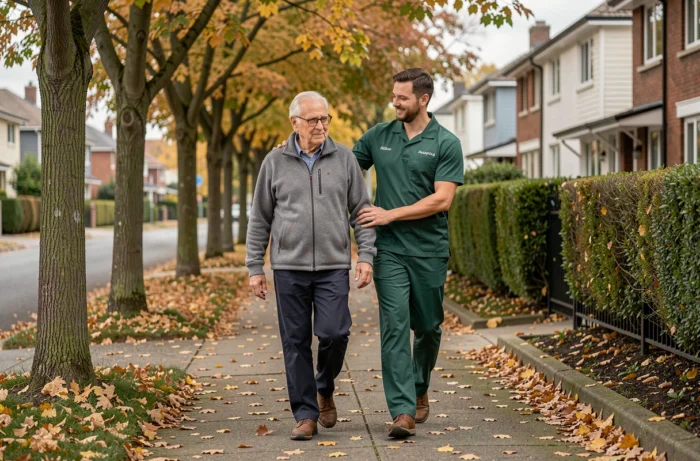
Assistance for seniors is often associated with housekeeping or personal care. The actual scope is broader. Since decree n° 2023-608, supplemented by the budget circular of May 22, 2024, support now includes shopping, leisure, civic life, and transportation, within the limits of the notified aid plan.
This evolution changes the game for seniors who are not bedridden but whose mobility or fatigue makes certain outings impossible without help. Going to vote, participating in a community activity, shopping at the local market: all of this now falls within the scope of funded support.
Why This Expansion Matters in Daily Life
Social isolation is a well-documented aggravating factor in the loss of autonomy. A senior who no longer leaves their home gradually loses their bearings, physical condition, and social connections. Allowing support for outings is not a luxury; it is prevention.
Specifically, a caregiver can now:
- Drive the person to the supermarket and help carry their bags, rather than limiting themselves to an impersonal delivery
- Accompany them to a conference, workshop, or cultural outing organized by the municipality
- Ensure transportation to a medical appointment while remaining present in the waiting room if necessary
- Facilitate administrative procedures at the town hall or with social organizations
Feedback varies by department regarding the speed of effective implementation of these supports, but the legal framework is established.
Coordination Between Assistance and Care: The Role of the Departmental Public Autonomy Service
The law of April 8, 2024, is not limited to merging structures. It also creates the departmental public autonomy service (SPDA), a one-stop shop intended to guide seniors and their families to the right resources.
The idea is to put an end to a familiar obstacle course: calling the CLIC, then the MDPH, then the department, then the CPAM, with no one providing the same information. The SPDA is meant to become the centralized entry point.
What This Means for Choosing a Home Care Provider
When looking for assistance for an elderly parent, we often compare the services offered: housekeeping, meals, personal care. The reform encourages us to also consider the provider’s ability to coordinate with healthcare professionals. A service that operates in a silo, without links to the home nurse or primary care physician, no longer fits the model towards which the system is moving.
Organizations that anticipate this evolution are already offering shared tracking tools among caregivers, regular coordination meetings, and a single point of contact for the family.
Home Care for Seniors: Concrete Criteria for Evaluating a Service
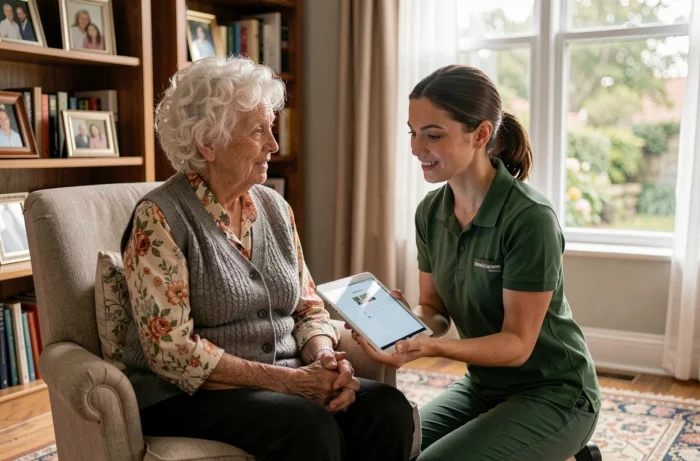
Beyond brochures and promises, several points allow for assessing the actual quality of a senior support service.
- The stability of caregivers: high turnover disrupts the senior’s habits and generates anxiety. Asking about the staff turnover rate is legitimate
- Responsiveness in case of absence: what happens when the usual caregiver is sick? A good service has a replacement plan within 24 hours
- The actual scope of intervention: some providers still limit their support to strict home care, without offering outings despite the regulatory expansion
- Price transparency: the out-of-pocket cost after deducting the APA aid plan must be clearly stated before any contract is signed
A service is not evaluated solely by its list of offerings but by its ability to meet its commitments over time, including when the senior’s needs evolve.
The landscape of senior assistance is undergoing profound restructuring. Families that take the time to verify their provider’s adaptation to these new regulatory requirements gain peace of mind, and their loved ones benefit from improved daily support.