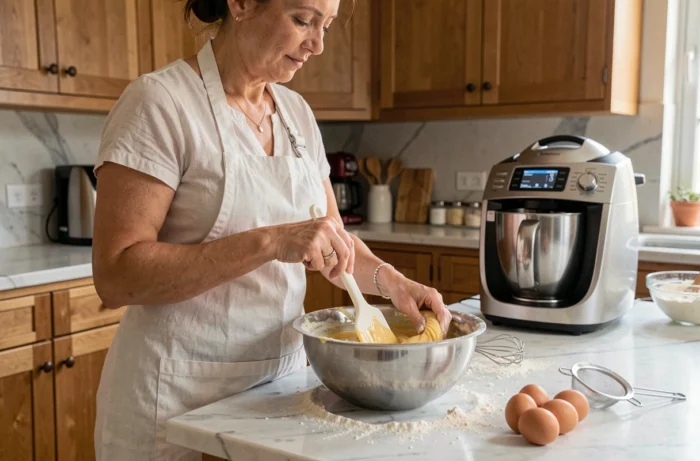
The Joconde biscuit relies on a fragile balance between the aeration of the egg whites, almond flour content, and the incorporation of melted butter. Preparing this recipe in the Thermomix requires rethinking the sequence of steps compared to using a stand mixer. Here, we detail the technical points that make the difference between a flat biscuit and a soft sheet, ready to line a dessert or an opera cake.
Managing the aeration of egg whites in the Thermomix bowl
The Thermomix whisk does not generate the same type of aeration as a planetary mixer. The volume of the bowl and the shape of the accessory limit the incorporation of air into the egg whites, which necessitates breaking down the whipping into several stages.
We recommend whipping the egg whites in three distinct phases. Start at low speed to break the structure, then gradually increase. Adding the sugar in a fine rain during the last phase stabilizes the meringue and prevents graininess. The most common mistake is to start directly at high speed, which produces a coarse foam that collapses as soon as it is incorporated into the almond paste.
Another constraint is the need to open the lid to visually check the texture. On recent models like the TM7, the touchscreen guides the preparation, but visual control of the consistency remains necessary for aerated devices. No automatic mode can replace the assessment of the bird’s beak formed by the meringue at the end of the whisk.
To obtain the complete recipe with precise settings for each step, the version offered as a Joconde biscuit in the Thermomix on Commande Gourmande details the durations and speeds suitable for each phase of aeration.
Almond flour and flour ratio: calibrating the texture of the Joconde biscuit
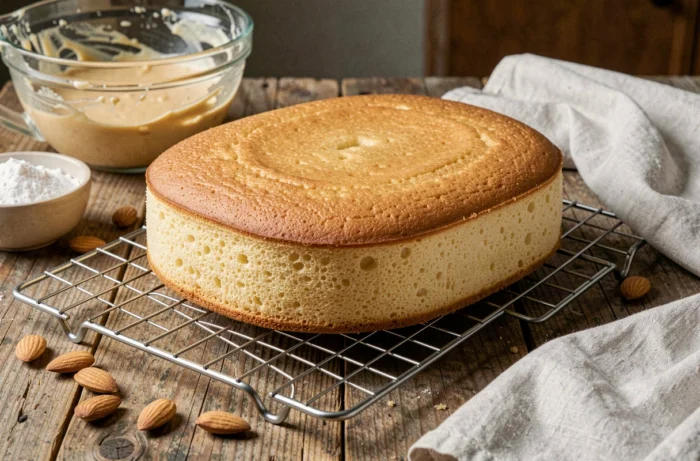
The proportion of almond flour to flour directly determines the softness of the biscuit. A Joconde intended for an opera cake, which will be soaked in coffee syrup and layered with chocolate ganache and coffee buttercream, has different requirements than a Joconde for a rolled log.
Almond flour: the structuring parameter
Almond flour provides moisture and flavor, but also fat that slows down drying. A high ratio of almond flour to flour produces a more melting biscuit, ideal for desserts where the biscuit is only a thin layer. Conversely, the mechanical stability decreases.
For a rolled cake, we prefer to rebalance by slightly increasing the amount of flour. The dough remains soft enough for hot rolling but does not tear when unrolling.
The role of melted butter in the recipe
Melted butter is incorporated last, just before spreading on the tray. Its addition in the Thermomix requires a delicate mixing technique. The method involves taking a small amount of batter, mixing it with warm butter in a separate container, and then returning it all to the bowl.
- Butter too hot: it causes the egg whites to collapse and produces a dense biscuit, lacking the characteristic aeration of the Joconde.
- Butter too cold: it solidifies upon contact with the mixture and creates visible greasy spots during baking.
- Target temperature: the butter should be melted but barely warm to the touch, allowing for homogeneous incorporation without breaking the aerated structure.
Baking the Joconde biscuit: settings and common pitfalls
Baking is the moment when most errors become irreversible. An overcooked Joconde loses its softness and becomes brittle when assembling the dessert.
The oven must be preheated to a high temperature. The goal is to quickly set the biscuit to fix the aerated structure before the air bubbles escape. Baking too long at a moderate temperature dries out the mixture deeply.
The thickness of the tray plays a direct role. For a classic opera, we spread the batter to a uniform thickness, ensuring even baking. The edges, being thinner, bake faster: monitoring the peripheral coloring allows for anticipating the point of removal.
Check the baking without opening the oven too soon
Opening the oven door during the first few minutes causes a thermal shock that makes the biscuit collapse. Wait until the surface is evenly golden before any checks. The touch test remains the most reliable: the biscuit should spring back when lightly pressed in the center.
Joconde biscuit for opera or desserts: adapting the recipe for the final assembly
The Joconde is not a standalone preparation. Its formulation adjusts based on the target dessert.
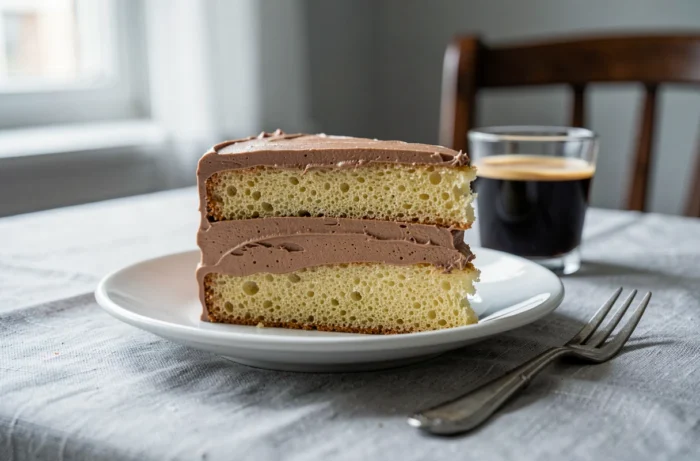
- For an opera: the biscuit receives a coffee syrup before being layered with chocolate ganache and coffee buttercream. The sheet must be firm enough to support the weight of the upper layers without collapsing.
- For a fraisier: softness takes precedence over stability. The biscuit will be in contact with a mousseline cream and fruits, which add moisture. A slight excess of almond flour in the recipe compensates for this moisture input.
- For a rolled log: softness during rolling is the determining criterion. Rolling the biscuit immediately after it comes out of the oven, while still warm, in a damp cloth sets the shape without cracking.
In each case, the Thermomix simplifies the preparation of the almond paste by ensuring a homogeneous mixture, but the critical step remains the manual incorporation of the meringue. This is a pastry chef’s gesture that the machine cannot accomplish: lifting the mass with a spatula from the bottom, turning the bowl a quarter turn with each movement.
The Joconde biscuit in the Thermomix gains consistency in the mixing of almond flour, eggs, and sugar. The limit always lies in the same place: the aeration of the egg whites and their incorporation. Mastering these two gestures transforms an accessible recipe into a professional-level result, regardless of the Thermomix model used.