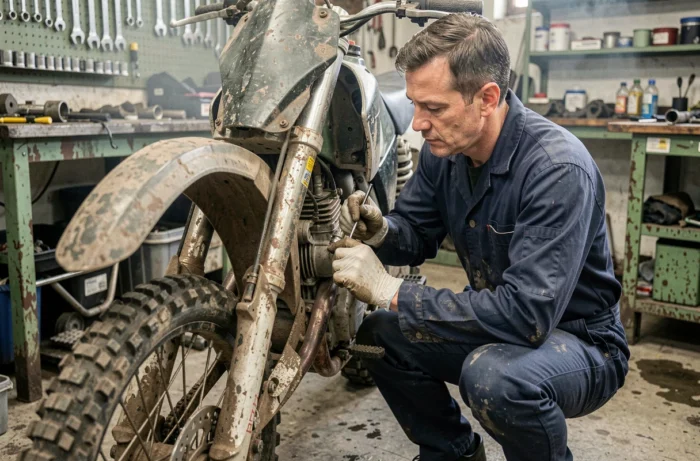
A dirt bike that stutters on acceleration has a combustion issue: the air-fuel mixture is not reaching the cylinder properly, or the spark is not occurring at the right moment. The engine receives a throttle input, but instead of revving up, it hesitates, coughs, or loses power in jerks.
This symptom affects both 125 pit bikes and smaller models. The cause is almost always found in the fuel system, ignition, or a vacuum leak.
Role of the carburetor circuits according to throttle position
On a carbureted dirt bike, three distinct circuits manage the mixture based on the position of the throttle. Understanding which one is active at what moment allows for pinpointing the issue without disassembling the entire carb.
The idle circuit supplies the engine when the throttle is closed or barely open. If the stuttering occurs only at startup or when coming off idle, this circuit is the first to check: mixture screw, idle jet, clogged passage.
The needle and slide take over in the intermediate range, between a quarter and three-quarters throttle. Stuttering in this area points to a mispositioned needle (clip too high or too low) or a slide that is not moving smoothly in its housing.
The main jet comes into play at wide open throttle. An engine that stutters at full throttle after a proper rev-up often indicates a main jet that is too small or partially clogged. Understanding why my dirt bike stutters at a specific RPM prevents unnecessary part replacements.
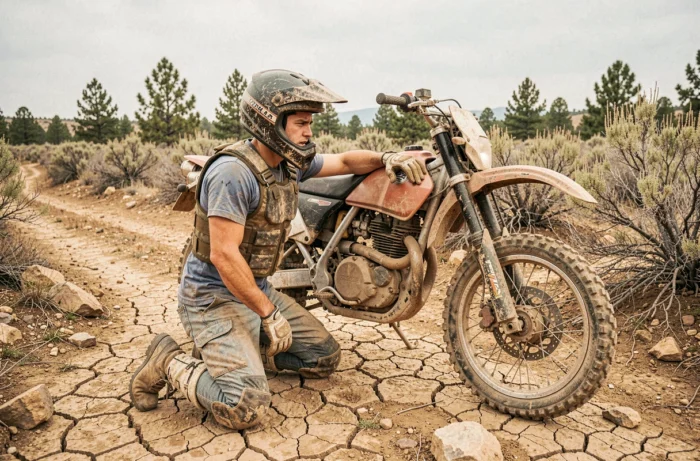
Air leak on the intake manifold: a false carburation problem
Before touching the carburetor, one must eliminate a common and underestimated cause: the air leak. The sleeve connecting the carburetor to the engine can crack, come loose, or lose its seal due to vibrations.
An air leak at the intake manifold allows unmetered air to enter the cylinder. The mixture becomes randomly lean, causing misfires similar to a poor adjustment. Confusion is common, and many riders change jets when the problem stems from a loose gasket or clamp.
Diagnosing an air leak without specific tools
The simple method involves spraying a bit of brake cleaner or WD-40 around the intake sleeve while the engine is idling. If the RPM changes suddenly (either increases or decreases), air is entering through that spot. Also check the condition of the head gasket and the tightness of the carburetor on the intake manifold.
A new carburetor can also cause an air leak if its diameter does not exactly match the original sleeve. After a replacement, immediate stuttering points to an installation defect or inappropriate calibration rather than a need for fine-tuning.
Ignition and CDI: when the spark is lacking on a dirt bike
The ignition circuit is the second major culprit for an engine that stutters. On most pit bikes and dirt bikes, the ignition relies on a CDI (Capacitive Discharge Ignition) unit that sends the pulse to the coil, then to the spark plug.
A faulty CDI can produce an intermittent spark: the engine runs correctly at low RPM but misfires on acceleration, or vice versa. The problem is often thermal, meaning that stuttering appears when the engine heats up and disappears when cold.
Spark plug and coil: basic checks
Before suspecting the CDI, two quick checks can eliminate the simplest causes:
- Remove the spark plug and examine its electrode. A black and dirty plug indicates a mixture that is too rich, while a white plug indicates a mixture that is too lean. In both cases, the spark loses effectiveness and the engine stutters.
- Test the spark by placing the plug against the cylinder head (with its resistor) and kicking it over. The arc should be blue and steady. An orange, weak, or intermittent arc points to the coil or CDI.
- Check the condition of the spark plug wire and the resistor. On dirt bikes, vibrations can damage connections, creating false contacts that resemble a carburation problem.
An engine that stutters only when hot points to an electronic component sensitive to temperature, typically the CDI or the high-voltage coil.
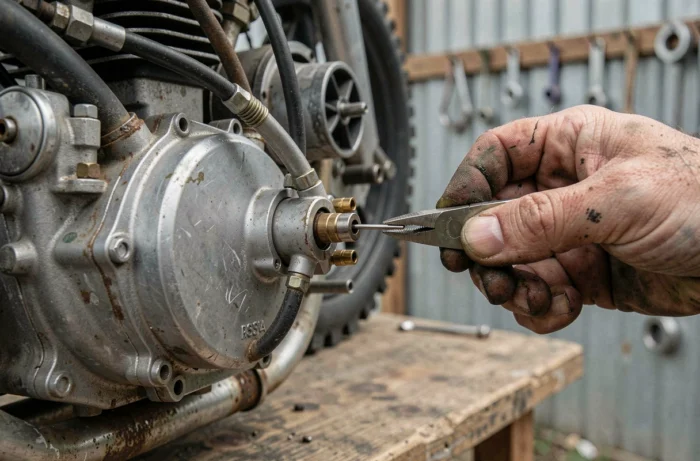
Degraded fuel and storage: an overlooked cause on dirt bikes
A dirt bike that sits for several weeks without running accumulates an invisible problem in its tank. Fuel degrades over time: lighter compounds evaporate, leaving a lean mixture, sometimes accompanied by deposits in the carburetor passages.
The ethanol present in common fuels exacerbates this phenomenon. It absorbs ambient moisture and forms a water-ethanol mixture that settles at the bottom of the tank and the carburetor bowl. The result: a stutter at the first turns after a long period of inactivity.
Drain rather than guess
The solution involves a complete draining of the tank and carburetor bowl, followed by refilling with fresh fuel. If the dirt bike needs to remain stationary for several weeks, closing the fuel tap and running the engine until it stalls helps empty the circuit. A fuel stabilizer in the tank limits degradation during winter storage.
Carburetor adjustment based on weather and altitude
Even a perfectly tuned carburetor can cause stuttering if conditions change. The cold, dense air of winter enriches the mixture compared to a setting made in summer. At altitude, atmospheric pressure drops, and the mixture also becomes richer.
Manufacturer jetting manuals provide charts correlating temperature, altitude, and jet size. Changing a jet without consulting these charts is akin to adjusting randomly. On a dirt bike used year-round or transported in the mountains, having a spare set of jets and noting the settings that work in each season prevents starting from scratch each outing.
The stuttering of a dirt bike is rarely resolved by replacing a single part. The most reliable method remains to proceed by elimination: check the age of the fuel, inspect the intake sleeve, check the spark plug and spark, then adjust the carburetor based on the RPM where the problem appears. Each step takes a few minutes and requires only common tools.