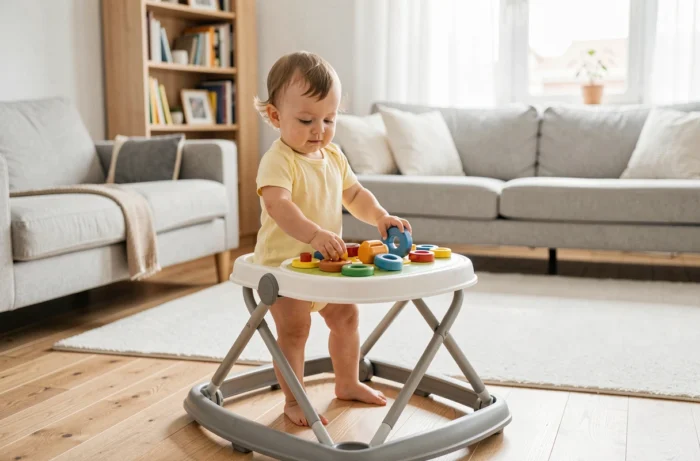
A baby who has been sitting independently for a few weeks, a living room with smooth tile flooring, and a doorway threshold between the kitchen and the hallway: this is the setting in which most parents start wondering about baby walkers. Choosing a baby walker is about more than comparing colors or activity trays. The layout of your home, your child’s stage of development, and the product’s actual compliance with safety standards matter far more than its design.
Baby walkers and your home’s layout: the factor no one checks first
People often think about product safety before considering the safety of the space. Even a walker that meets safety standards can be problematic if your child can move near stairs, a raised threshold, or a sloping surface. The wheeled base also gives them access to objects placed higher up that they couldn’t reach before.
Before buying, take a look around the rooms your child can access. Steps, thick rugs, cables on the floor, unstable furniture: every obstacle changes the equation. A stable model cannot make up for an inadequately prepared environment. If your home has changes in floor level, safety gates at critical points are essential, whether the walker is high-end or not.
For a comparison of available models and their features, one useful resource is https://www.youpala-bebe.fr/, which brings together different types of baby walkers and their specifications.
Smooth floors (tile, varnished parquet) make it easier for your child to move around quickly. On these surfaces, choose a walker with a braking system or speed-reducing pads on the wheels. With low-pile carpet, the problem is the opposite: wheels that are too small get stuck and frustrate your child.
Baby walker safety standards: what the label should say
European standard EN 1273 governs the manufacture of seated baby walkers. It requires stability, strength, and tip-over prevention tests. A product sold in France must state that it complies with this standard.
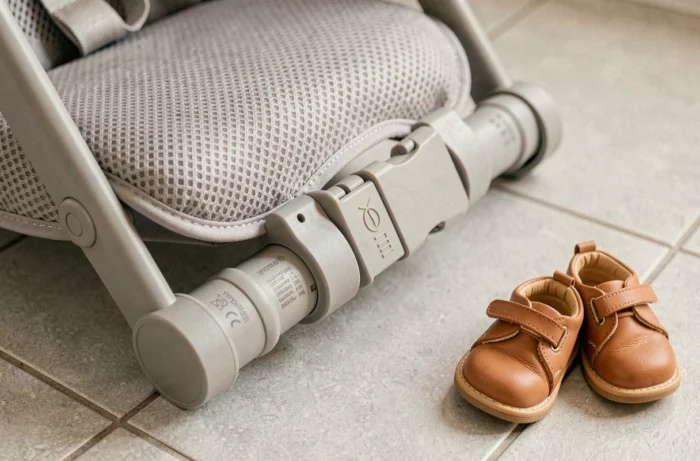
Here’s what to do: check for the standard directly on the packaging or product, not just in the online product description. DGCCRF inspections regularly flag issues such as incorrect labeling and warnings that are hard to see or not translated into French. A baby walker with safety instructions written only in English or in tiny print presents a real problem, even if it’s sold on a French website.
What to check before buying
- An explicit reference to standard EN 1273 on the label or instructions, in clear French
- Translated warnings about the minimum age, maximum weight, and the prohibition on use near stairs
- No small detachable parts that the child can reach while seated in the walker
- The width of the base: it should prevent the walker from passing through a standard doorway if that doorway opens onto a hazard (this simple test can be done in store)
Worth noting: Canada has banned the sale, import, and advertising of seated baby walkers since 2004. If you travel with a baby walker or buy one abroad, compliance with French standards does not guarantee compliance elsewhere.
Your child’s age and development: when a baby walker makes sense
Place a baby in a walker once they can sit up unaided and show an interest in standing. For most children, this stage begins at around eight months.
If used too early, the child puts strain on muscles that aren’t ready. If used too late, the walker loses its usefulness because the child is already walking or about to start. A baby walker supports a transitional stage; it does not teach a child to walk from start to finish.
Daily use matters just as much as age. Short sessions (around 20 minutes) give your child time to explore other positions on the floor, crawl, and pull themselves up against furniture. A walker does not replace floor time, which remains the main driver of motor development and balance.
Baby walker, ride-on toy, or push walker: which model for each stage?
A ride-on toy (the child sits on it and moves forward with their feet) is suitable once a baby can sit up and wants to move around on the floor. A push walker comes later, when the child can stand up on their own and starts taking steps while holding on. A seated baby walker falls between the two: the child is held in an almost upright position, with their feet touching the floor, while the seat supports some of their weight.
Choosing between these three options depends on what your child does naturally. If they crawl and pull themselves up but can’t stand without help, a baby walker may give them the experience of moving around upright. If they’re already taking steps along furniture, a push walker will be better suited to their stage.
Wheels, seat, and height adjustment: technical details that make a difference
Wide wheels and a flared base reduce the risk of tipping over. On a budget model, the wheels are often small and made of hard plastic, making them noisy on tile and unstable over floor joints.
- The seat should be padded, washable, and height-adjustable to accommodate your child’s growth over several weeks of use
- Height adjustment ensures your child’s feet rest flat on the floor, rather than being on tiptoe or dangling above it
- A removable activity tray makes cleaning easier and frees up space when your child simply wants to move around
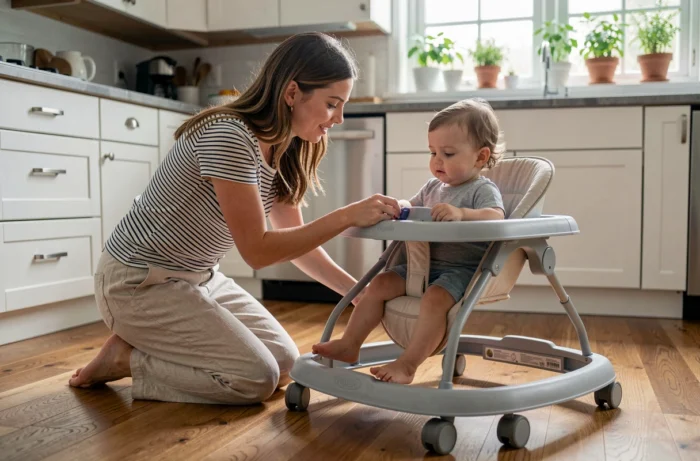
With the right adjustment, your child’s feet rest flat on the floor, never on tiptoe. If your child pushes off only with their toes, the seat is too high or the model isn’t the right size.
Compact folding is an underrated practical feature. In an apartment where space is limited, a baby walker that folds flat can be stored in a closet between uses, rather than left in the middle of the way.
Choosing a baby walker comes down to a simple order of priorities: first the environment, then your child’s stage of development, and finally the model’s technical features. A walker that complies with standard EN 1273, used in a safe space and for reasonable periods, can serve its purpose without compromising your child’s overall motor development.