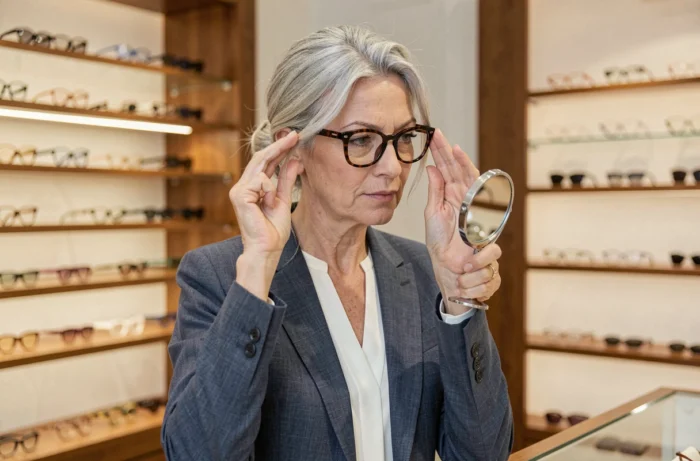
Graying changes the colorimetric game well beyond a simple hair change. The loss of melanin in the hair is accompanied by a global decrease in contrast between skin, eyebrows, and hair. Choosing the color of your glasses with gray hair is about restoring a visual frame that natural aging progressively blurs.
Facial Contrast and Gray Hair: The Compensatory Role of the Frame
The frame is not just an aesthetic accessory when hair turns gray. It becomes a tool to compensate for the lost contrast between skin and hair. An optical guide published in August 2026 by Bright Side Optical emphasizes this point: choosing an “age-appropriate” frame does not mean discreet or invisible, but relevant and readable.
Specifically, a face framed by gray hair and a transparent or flesh-toned frame loses all visual structure. The eye of the person opposite can no longer find a reference point. We recommend thinking in terms of tonal value rather than personal taste: the frame should stand out enough from the gray of the hair and the tone of the skin to restore definition to the features.
To determine which color of glasses with gray hair is best suited, you must first assess whether your gray leans towards cool silver or warm salt and pepper, as this undertone guides the rest of the choice.

Undertone of Gray and Temperature of the Frame: The True Selection Criterion
Gray is not a single color. A former dark brown that is graying often retains warm highlights (amber salt and pepper), while an ash blonde turning gray shifts towards cool silver. This distinction directly dictates the temperature of the frame.
Silver Gray or Pure White: Focus on Cool Undertones
Silver gray or white hair harmonizes with frames that have a cool dominance. Navy blue, plum purple, deep burgundy, and steel gray work particularly well. Brushed silver or gunmetal on metal frames creates a tonal continuity without monotony.
Avoid warm gold or honey tortoiseshell frames on silver gray: the temperature mismatch gives a washed-out appearance to the entire face.
Salt and Pepper or Warm Gray: Dare to Use Controlled Warmth
When gray retains warm pigments, havana tortoiseshell, bronze, terracotta, or olive green frames find their place. The contrast remains readable because the undertone of the hair and that of the frame speak the same chromatic language.
- Classic tortoiseshell (brown-amber): a safe bet on salt and pepper, it structures the gaze without hardening it
- Kaki or olive green: an earthy tone that works on medium to dark skin with warm gray
- Warm burgundy (leaning towards marsala): adds color while staying within the warm undertone range
- Bronze or rose gold: on metal frames, an alternative to classic gold that avoids excessive shine
Frame Color According to the Type of Glasses: Prescription, Sunglasses, Progressives
Technical constraints vary according to use, and color is not chosen in the same way for a prescription frame worn twelve hours a day and for an occasional pair of sunglasses.
Prescription Glasses and Progressives
The prescription frame is the one that constantly interacts with the face. We observe that a frame that is too saturated (bright red, lemon yellow) visually tires with daily wear, especially with gray hair that amplifies every color flash by contrast.
On progressive lenses, the height of the frame is often more important, which increases the visible colored surface. It is better to opt for moderately saturated shades: ink blue, plum, dark tortoiseshell, or matte black. Shiny black, on the other hand, can create too sharp an effect on mature skin.
Sunglasses and Gray Hair
With sunglasses, there is more freedom. The frame is worn outdoors, often paired with summer attire. Bright colors (orange, turquoise, brick red) work better here than in optical wear, because the bright context and duration of wear limit visual fatigue.

However, be careful with the tint of the sunglasses: a brown-amber lens on a cool frame creates a chromatic conflict. We recommend aligning the temperature of the lens with that of the frame.
Structured Shapes and Color: A Combination to Master with Gray Hair
The recent trend, notably highlighted by Freundin in 2026, showcases very marked glasses shapes (angular aviators, heavily structured frames) among women with gray hair over fifty. The shape amplifies the effect of color: a navy blue aviator frame has a much stronger visual impact than a discreet rectangle in the same shade.
This is not trivial. On a face where natural contrast has diminished, a bold geometric shape combined with a well-chosen color acts as a double lever of definition. Conversely, a thin round shape in a pastel color risks disappearing.
- Angular shape (rectangle, aviator, structured cat-eye): supports bold and strong colors
- Round or pantos shape: prefer deep colors rather than light ones to maintain presence
- Semi-rimless frame: the colored upper bar frames the gaze, ideal in tortoiseshell or midnight blue
The Most Common Color Mistakes with Gray Hair
Some combinations regularly come up in consultations and consistently produce disappointing results. Beige and nude on gray hair erase the face instead of softening it. The frame blends into the skin, and the gaze loses all anchoring.
Optical white poses a similar problem: on white or light gray hair, a white frame creates a uniform mass without contrast. The result is a “washed-out” effect that most wearers are precisely trying to avoid.
Bright yellow gold on cool gray produces an immediately perceptible temperature conflict. If you prefer gold metal, opt for rose gold or champagne, which temper the warmth without eliminating it.
Lastly, a often overlooked point: the color of the temples. A well-chosen face in midnight blue loses its coherence if the temples are in light tortoiseshell. On gray hair, the frame is visible from the side as much as from the front. The chromatic harmony must work from all angles.