
A Breton entrepreneur looking to develop their clientele or structure their professional network often faces a concrete problem: where to work, exchange ideas, and become visible outside their office or home? Dedicated business spaces provide a direct answer to this question. They are multiplying in Brittany, driven by a strong regional dynamic, and their role goes far beyond simply providing a workstation.
Third Places in Brittany: An Underestimated Local Employment Lever
Have you noticed that coworking spaces and third places no longer resemble the impersonal open spaces of the early 2010s? In Brittany, these places have become true employer structures.
According to the Third Places Observatory, 70% of Breton third places are employers, representing more than 500 full-time equivalents in the region. This figure places Brittany among the territories where these spaces truly impact the local economic fabric.
Another rarely mentioned feature: about 70% of the employees in these structures are women. The roles in support, community management, and administrative management that keep a business space running attract diverse profiles, and this feminization distinguishes the sector from many other tertiary fields.
For a leader of a micro or small business, settling in a Breton third place also means contributing to an ecosystem that generates qualified employment in their territory. Several Breton entrepreneurs looking to gain regional visibility go through the business space of Portail Breton to identify partners and resources suited to their sector.
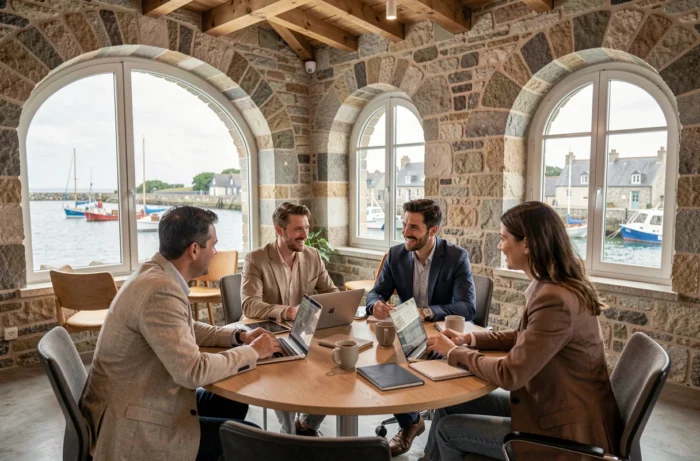
Dedicated Business Space: What the Format Changes for an Activity
A dedicated business space is not limited to a shared office with a Wi-Fi connection. The difference lies in three concrete elements that transform the way of working on a daily basis.
- An integrated professional network: the other occupants of the space are not just office neighbors. Networking events (workshops, pitches, themed lunches) create direct business opportunities among members.
- Access to shared services: equipped meeting rooms, videoconferencing equipment, client reception areas. Each expense that you do not bear alone reduces your fixed costs.
- An identifiable professional address: for a growing company, having a dedicated reception area enhances credibility with prospects and institutional partners.
Why does this format work better than a simple coworking subscription? Because a business space targets a community of entrepreneurs with growth objectives. The exchanges are focused on business development, not just sharing square meters.
Choosing Your Business Space in Brittany: Criteria That Make a Difference
Not all spaces are created equal, and the price per square meter is not the first criterion to consider. Here’s what really matters when looking to boost your activity.
The Quality of the Present Community
A space that hosts isolated freelancers and another that brings together SME leaders in the structuring phase do not produce the same effects. Before signing, ask for the list of member companies or attend an open event. The value of a business space is first measured by its network.
Location Relative to Your Client Territory
In Brittany, economic dynamics vary significantly between metropolitan areas (Rennes, Brest, Lorient) and more rural zones. A business space in Saint-Grégoire, on the outskirts of Rennes, does not serve the same function as a third place in Peillac, in Morbihan. The right choice depends on where your clients and partners are located.
The Support Services Offered
Some spaces integrate entrepreneurial support programs, with mentoring, workshops on digital development, or financial structuring. The Chamber of Trades and Crafts of Brittany, for example, offers online workshops to boost activity through digital means. Prioritize spaces that offer a real program, not just a lease.

Brittany’s Regional Dynamic: Why the Time is Right
At the national level, there were approximately 3,500 third places in 2023. This figure is expected to rise to around 4,050 by 2026 according to the Third Places Observatory. Brittany is among the most active regions in this expansion.
This growth is not a passing trend. It reflects a structural change in how companies occupy space. The model of fixed offices with traditional commercial leases is declining in favor of more flexible arrangements, suited to micro and independent businesses that want to limit their financial commitments while benefiting from a professional environment.
For a Breton entrepreneur, this densification of business space networks means easier access to quality locations, even outside major urban areas. Rural third places, like the one in Peillac that recently celebrated its tenth anniversary, demonstrate that the model works even far from urban centers.
The Brittany Region actively supports this dynamic, with dedicated support programs for innovative businesses and targeted aid for territorial development. Relying on a local business space means being part of a structured regional ecosystem, not just renting an office.
The choice of a business space in Brittany is based on a precise analysis of needs: network, location, services. Entrepreneurs who make the most of these places are those who use them as an active commercial development tool, not just as a simple relocated workstation.