
Among the dozens of tools stored in a toolbox, those whose names start with the letter M appear with notable frequency: hammer, mallet, tape measure, angle grinder, caulking gun. Their common point is not limited to the initial. Several of these tools cover very different functions (striking, measuring, cutting, finishing), which makes their comparison useful before any bulk purchase.
Which M tools truly deserve a place in a home workshop, and on what criteria should they be distinguished?
Comparison of M tools: uses, materials worked, and lifespan
Grouping these tools in a table allows for a quick visualization of their respective fields of application and identification of any potential duplicates.
| Tool | Main Function | Materials Concerned | Powered | Spare Parts (AGEC Law) |
|---|---|---|---|---|
| Carpenter’s Hammer | Drive / remove nails | Wood, plaster | No | Not applicable |
| Mallet | Heavy striking, light demolition | Stone, concrete, tiles | No | Not applicable |
| Caulking Gun | Sealing, bonding | Wood, PVC, masonry | No | Not applicable |
| Tape Measure | Length measurement | All | No | Not applicable |
| Angle Grinder | Cutting, deburring, sanding | Metal, stone, tiles | Yes | Minimum availability of 5 years |
| Multimeter | Electrical diagnostics | Circuits, wiring | Electronic | Not applicable (not powered) |
| Caulk (gun) | Sealing, bonding | Wood, PVC, masonry | No | Not applicable |
The “Spare Parts” column deserves special attention. For powered tools like the angle grinder, the AGEC law and the Climate and Resilience law impose a minimum availability of spare parts for 5 years from the date of market release. Before purchasing a low-end angle grinder, checking this information with the manufacturer helps avoid ending up with an irreparable device after two years.
Consulting a list of M tools dedicated to home improvement helps spot other lesser-known references, such as the mini-saw or the straight grinder, often absent from general guides.
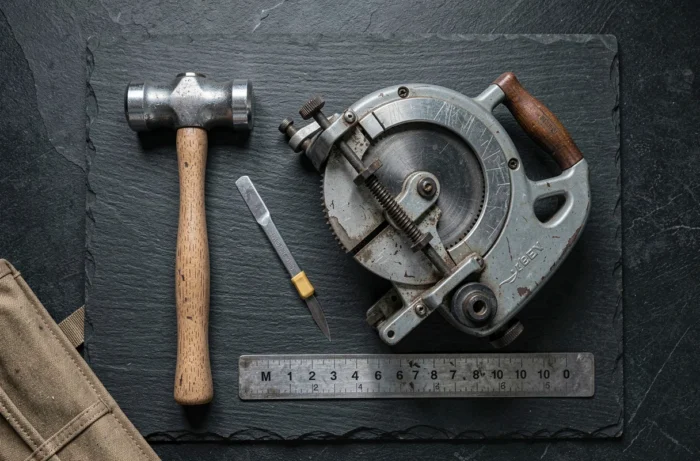
Hammer, Mallet, and Caulking Gun: Three Striking Tools with Distinct Roles
These three tools look similar visually, which leads many DIYers to buy only one. This is a mistake that affects the quality of work and the longevity of assembled parts.
The Carpenter’s Hammer vs. the Mallet
The carpenter’s hammer has a hardened steel head. It transmits a concentrated force, ideal for driving a nail into soft wood or plaster. However, using this same hammer to adjust a mortise and tenon joint risks marking the wood. The mallet, with its rubber or hardwood head, absorbs the shock and protects the surface of the workpiece.
The Mallet for Masonry Work
The mallet weighs significantly more than a standard hammer. It is used to strike a chisel to remove tiles, break a concrete edge, or adjust concrete blocks. Paired with a chrome-plated chisel, it covers most small demolition tasks without resorting to an electric hammer.
- Carpenter’s Hammer: ergonomic non-slip handle, head weight between 300 and 500 g depending on usage frequency
- Mallet: prefer an interchangeable head (hard rubber on one side, nylon on the other) for varied uses
- Mallet: check the fitting (a through-fitting limits the risk of head-handle disconnection)
Angle Grinder: The Only Powered M Tool to Check Before Purchase
The angle grinder is probably the most versatile M tool in a workshop. With a cutting disc, it cuts metal or tiles. With a flap disc, it sands and deburrs. With a wire brush, it removes rust. This versatility has a downside: each disc imposes a maximum rotation speed that must not be exceeded, under penalty of dangerous breakage.
The European GPSR regulation, applicable since December 13, 2024, strengthens traceability requirements for non-food consumer products. For an angle grinder sold in France, this means that the manufacturer or importer must retain information on the supply chain for several years. A serious guarantee to check: the presence of CE marking and a manual in French detailing the allowable speeds by disc type.
Practically, two criteria separate a reliable angle grinder from a disposable model:
- The disc changing system: a keyless mechanism (SDS-click or equivalent) reduces intervention time and limits risky handling
- The availability of motor brushes and protective cover: these wear parts must remain accessible for at least five years in accordance with the AGEC law
- The disc diameter: 125 mm is sufficient for most domestic tasks, while 230 mm is aimed at deep cuts in stone or concrete

Tape Measure and Multimeter: Measure Before Cutting or Connecting
The tape measure remains the most used tool on any home project. A quality model is recognized by the rigidity of its extended blade: a blade that stays straight for over a meter without bending makes solo measurements easier. The nylon coating on the blade limits wear on the graduations over time.
The multimeter, on the other hand, comes into play whenever work touches the electrical circuit of the house. Checking the voltage of a socket, testing the continuity of a wire, measuring the resistance of a component: these operations require a reliable device. For home use, a digital multimeter with a safety category of CAT III covers common needs (sockets, electrical panel, lighting).
These two measuring tools are inexpensive to purchase, but a low-end model can skew readings and lead to cutting errors or, in the case of the multimeter, incorrect electrical diagnostics.
Among all the M tools reviewed, the angle grinder concentrates the most significant issues: versatility, safety, reparability. Hand tools (hammer, mallet, caulking gun, tape measure) remain durable purchases as long as quality materials are chosen. As for the multimeter, its presence in the toolbox transforms a cautious DIYer into an autonomous DIYer for small electrical tasks.