
A trickle of warm liquid that flows unexpectedly, a persistent feeling of dampness in the underwear, the inability to distinguish between a urinary leak and the flow of amniotic fluid: a rupture of the amniotic sac destabilizes most pregnant women. Unlike a complete rupture, where the fluid flows abundantly, a rupture produces a discreet, sometimes intermittent seepage that complicates home diagnosis.
The timing of induction after confirmed rupture at term
Recent clinical recommendations point towards a reduction in the waiting period when a rupture or leak is confirmed at term. The current trend favors induction of labor within 6 to 12 hours following confirmation, even in the absence of contractions.
The goal is to limit the risk of maternal-fetal infection. The longer the delay between the opening (even partial) of the membranes and delivery, the more bacteria present in the vagina can ascend to the amniotic fluid and reach the baby.
This point remains poorly understood by expectant mothers. Many testimonies on forums describe hours spent hesitating, changing panty liners, wondering if the fluid is coming from the bladder or the sac. However, this hesitation delays consultation and shortens the leeway available to the medical team. Midwives emphasize: a continuous, even light, flow that does not stop after emptying the bladder justifies a visit to the emergency room.
Several mothers report the same sequence. First, confusion with abundant vaginal discharge or a urinary leak. Then, a doubt sets in because the fluid is clear, odorless, and regularly wets the underwear. A collection of opinions and testimonials and opinions on amniotic sac rupture from midwives confirms that this hesitation is almost systematic, especially for a first baby.

Rupture of the amniotic sac or urinary leak: unmistakable signs
You may have noticed that towards the end of pregnancy, the pressure of the baby on the bladder causes leaks with the slightest effort? Coughing, sneezing, laughing a bit too hard: a few drops escape. Confusion with a rupture of the sac is common, but a few clues can help clarify the situation.
- The amniotic fluid is clear, sometimes slightly pink, and does not have the characteristic smell of urine. A urinary leak smells of ammonia, even faintly.
- The flow associated with a rupture does not stop when you contract the perineum. Urinary leaks, on the other hand, cease if you intentionally tighten.
- The flow is often irregular but continuous: the fluid returns with each change of position, when you stand up or turn in bed.
- In case of doubt, midwives advise emptying the bladder, placing a clean pad, and lying down for about twenty minutes. If the pad is wet again upon getting up, the likelihood of a rupture significantly increases.
At the maternity ward, the diagnosis relies on a pH test of the vaginal fluid. Amniotic fluid is basic (high pH), while vaginal secretions and urine are acidic or neutral. This quick test, performed in a few minutes, removes any ambiguity.
Early rupture before term: monitoring and infection risks
When the rupture occurs well before the expected delivery date, the situation changes radically. This is referred to as premature rupture of membranes (PPROM in English). The goal is no longer to induce labor quickly but to maintain the pregnancy for as long as possible while monitoring for infection.
Recent clinical practices show a shift towards outpatient monitoring in certain selected cases. Previously, prolonged hospitalization was the norm. Now, after an initial evaluation at the hospital (infection assessment, fetal monitoring, ultrasound of residual fluid), some women may return home under strict conditions.
What midwives prioritize in monitoring
The mother’s temperature is regularly checked. Any fever, even moderate, raises suspicion of chorioamnionitis, an infection of the membranes that necessitates rapid delivery regardless of the term.
The baby’s heart rate is also a reliable indicator. An abnormal acceleration or loss of variability in the rhythm alerts the team. Antibiotics are often administered preventively to protect the newborn against group B streptococcus, a bacterium commonly found in the vaginal flora.
Several testimonies from mothers who experienced early rupture describe weeks of extended hospitalization, with near-total bed rest and constant anxiety. The fear of infection and that of premature delivery intertwine. Midwives then play a role of psychological support as much as medical.
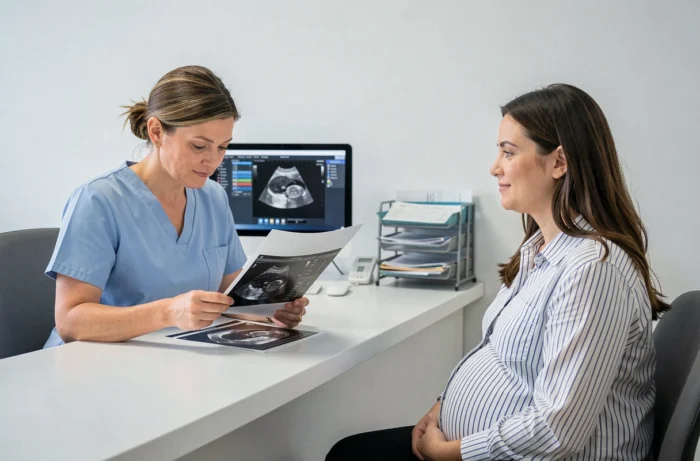
Actions to take and mistakes to avoid in case of suspected rupture
When doubt arises, certain reflexes protect the mother and baby, while others increase the risk.
- Do not insert a tampon or finger into the vagina. Any foreign body increases the risk of infection when the membranes are open, even partially.
- Note the time of the first suspicious flow. This information helps the medical team calculate the elapsed time and decide on induction.
- Go to the maternity ward within the hour if the flow persists after emptying the bladder. No need to wait for contractions.
Warm baths are also discouraged in case of suspicion. Bathwater can enter the uterus through the breach and carry germs. A quick shower is still possible, but without lingering.
The rupture of the amniotic sac remains one of the most difficult signs to interpret alone. Amniotic fluid is constantly being replenished, which explains why the flow may decrease and then resume. This variability keeps the doubt alive. It is better to go to the emergency room “for nothing” than to ignore a rupture for several hours, as time remains the main lever to prevent neonatal infection.