The market for pole saws has significantly expanded in recent years, with an offering that covers both professional gas models and battery-operated machines intended for homeowners. Choosing a pole saw suitable for one’s trees and garden requires understanding some technical distinctions that product sheets do not always highlight.
Machine regulations and noise level: what already influences the choice of a pole saw
Before comparing models, a rarely discussed point deserves attention: the European regulatory framework governing these tools is set to change. The regulation (EU) 2023/1230 will replace the directive 2006/42/EC starting January 20, 2027. This new text strengthens safety, documentation, and risk assessment requirements for all portable machines, including pole saws.
For a homeowner or landscaper investing today, this means it is relevant to prioritize models that are already compliant with the latest standards. Manufacturers anticipating this transition generally offer more comprehensive technical documentation and better-integrated safety devices.
The other regulatory constraint concerns noise. The European directive 2000/14/EC requires manufacturers to display a guaranteed acoustic power level on each machine intended for outdoor use. In residential areas, this criterion becomes crucial: municipal decrees strictly regulate the hours of use for motorized gardening tools.
A noisy pole saw significantly reduces the available time slots for work. Comparisons available on elagueuse-warrior.com allow users to compare the sound characteristics of different models, a parameter often overlooked at the time of purchase.

Battery or gas pole saw: the real differences in the field
The growth of lithium-ion battery pole saws is clear, driven by the absence of direct emissions and quieter operation. In urban areas or shared properties, these machines offer an immediate practical advantage. However, field feedback diverges on one specific point: the actual autonomy in difficult cutting conditions.
On small-diameter branches and softwood, a standard battery typically lasts for a full work session. As the diameter increases or the wood is hard (oak, hornbeam), energy consumption rises and autonomy drops significantly. Available data does not allow for a universal threshold, as duration depends on the battery model, the chain used, and the cutting technique.
Gas models maintain an advantage on extended jobs or those far from a power source. Their power remains superior at comparable displacement, and the lack of recharge time allows for continuous work. In contrast, weight, vibrations, and engine maintenance (filter, spark plug, carburetor) are constraints that battery models eliminate.
What the type of power source doesn’t reveal
The choice between battery and gas sometimes obscures a more structuring parameter: classic pole saw (top handle) or pole saw on a shaft. These two formats cater to distinct uses.
- The top handle pole saw is designed for work at height, operated with one hand by an operator positioned in the tree or on a platform. Its use on the ground is prohibited in France for safety reasons.
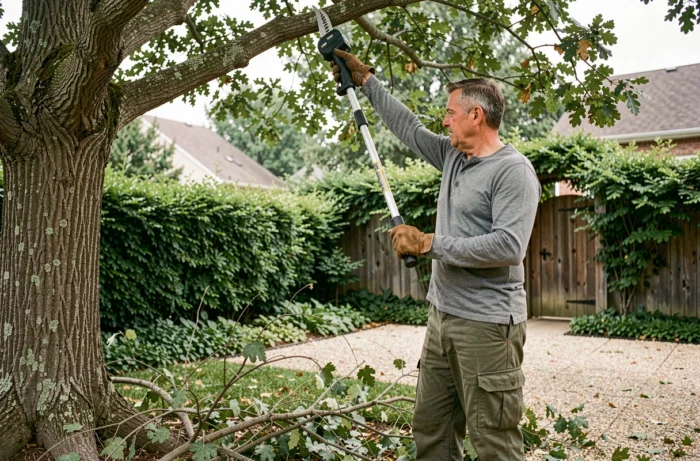
- The shaft pole saw allows reaching high branches from the ground, without a ladder or harness. The shaft length varies by model, and some telescopic versions exceed three meters in reach.
- The standard chainsaw, heavier and equipped with a longer guide, is intended for ground cuts and does not replace a pole saw for canopy work.
Confusing these formats leads to inappropriate purchases. A homeowner wishing to trim branches at height without climbing needs a shaft pole saw, not a top handle.
Guide bar and chain: the technical parameters that change the cut
The length of the guide bar determines the maximum diameter of branch that the pole saw can cut in a single pass. Common models for pruning offer guide lengths between 20 and 30 centimeters. A shorter guide provides more maneuverability in dense foliage, while a longer guide is suitable for larger diameter branches.
The type of chain directly affects the quality of the cut and safety. Low kickback chains reduce the risk of sudden recoil, a common accident among occasional users. A well-sharpened chain consumes less energy and puts less strain on the motor, which extends the autonomy on battery models.
Chain maintenance (tension, lubrication, sharpening) remains the same regardless of the type of power source. Neglecting this point quickly degrades cutting performance and accelerates guide wear.
Power-to-weight ratio and safety: deciding based on actual use
The weight of a pole saw is felt within the first few minutes of working at height. The lightest battery models weigh around three kilograms (without battery), while professional gas models often exceed this threshold. A difference of a few hundred grams can affect fatigue over a half-day of work.
Power, expressed in watts for electric models or in displacement for gas models, should correspond to the diameter of the branches to be cut. Oversizing the power increases the machine’s weight without real benefit if the work is limited to routine maintenance on thin branches.
On the safety side, several elements deserve verification before purchase:
- Presence of a quick-stop chain brake that halts rotation in case of recoil.
- Integrated anti-vibration system that limits the transmission of shocks to the hands and arms.
- Double-control safety switch to prevent accidental starting.
Wearing personal protective equipment (cut-resistant gloves, goggles, helmet with visor) remains necessary regardless of the chosen model.
Buying a pole saw while anticipating the transition to regulation (EU) 2023/1230, considering local noise constraints, and verifying the actual compatibility between the tool format and the trees to be maintained helps avoid the most common mistakes. The guide bar, chain, and power-to-weight ratio take care of the rest.