
The development of a baby relies on a sequence of sensory, motor, and cognitive phases that overlap from the very first weeks of life. Each milestone, from the first social smile to walking, depends on the quality of interactions with caregivers and the sensory richness of the daily environment. Understanding these mechanisms allows for an awakening that is adapted to the child’s real pace, without pressure or excess.
Parental technoférence and baby awakening: an underestimated barrier
The term technoférence refers to the interference of adult screens on the quality of parent-child exchanges. The issue is not limited to the infant’s screen time: it also includes the smartphone checked during feeding, meals, or floor play, which fragments the adult’s attention.
This fragmentation reduces the number of verbal and non-verbal interactions received by the baby in a day. However, these micro-exchanges (gaze, smile, word spoken in response to a coo) are the main fuel for the development of language and socio-emotional skills.
A concrete action is to place the phone out of visual reach during the infant’s active awakening phases. A baby a few months old already picks up on the adult’s diverted gaze, and the regularity of attention matters more than its total duration. Finding practical benchmarks suited to each age group is easier by consulting the baby section on Happy Family, which groups content by growth stage.

Screen-free awakening activities: selection criteria by age group
Offering relevant awakening games requires respecting the sensory and motor maturity of the baby at a given moment. Before choosing a toy or activity, three criteria deserve to be checked.
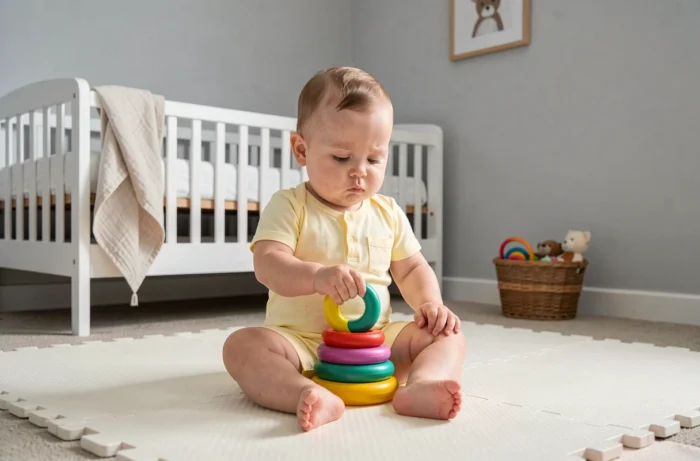
- Suitability with the motor stage: a lightweight rattle for an infant starting to grasp, a stacking object for a baby mastering fine motor skills. An object that is too advanced generates frustration, not stimulation.
- Multisensory engagement without overload: a crinkly fabric that produces a light sound engages touch and hearing simultaneously, without saturating attention. Electronic toys that combine lights, sounds, and vibrations often provoke a passive reaction rather than active exploration.
- Standardized safety: visible CE marking, absence of small detachable parts, materials compliant with current standards. Recent recalls of popular toys sold online for choking hazards remind us that checking the minimum age indicated on the packaging remains a reflex not to be neglected.
From birth to six months
The infant explores the world through the gaze, touch, and voice of their parents. Visual contrasts (black and white images), skin-to-skin contact, and softly sung nursery rhymes are enough to nurture their awakening. The human face remains the most powerful stimulus at this age.
From six to twelve months
The baby begins to sit up, manipulate, and explore space. Everyday objects (wooden spoon, stacking cup, box to open and close) provide rich experiences. The play mat placed on the floor allows them to crawl freely, which enhances motor coordination much more effectively than a bouncer.
New rules on screens in daycare and in the health record
Since January 2025, the health record given at birth includes a specific mention regarding screen exposure before three years old. This change shifts the recommendation from a simple oral pediatric advice to a written support that each parent keeps.
At the same time, the ban on screens in daycare and early childhood care facilities was strengthened in 2025. This measure shifts the question of digital awakening from being solely a family matter to a collective rule applicable to early childhood professionals.
For parents, the practical consequence is clear: care facilities no longer compensate for any excess screen time at home. The baby’s environment, regardless of the location, tends towards screen-free consistency during the early years.
Safety of awakening toys: concrete traps to avoid
Alerts published by the DGCCRF regarding very popular toys, particularly squishies, illustrate a recurring problem. These items, often purchased online without verification, may contain non-compliant chemical substances or pose a choking risk for young children.
Before introducing a new toy into the baby’s environment, a few quick checks significantly reduce risks:
- Check the CE marking and minimum age indication on the packaging, not just on the online product sheet.
- Check the integrity of each piece: a toy with elements that detach easily under pressure is not suitable for a child who puts everything in their mouth.
- Prefer simple materials (untreated raw wood, certified fabric) for objects intended for children under one year old.
- Be wary of “trendy” toys not referenced by distributors subject to European controls.
A safe and simple toy engages curiosity better than a fragile gadget overloaded with functions. Wood, fabric, and thick cardboard remain reliable choices for the first months.
Respecting the baby’s rhythm rather than multiplying stimuli
A child’s development does not accelerate by increasing the number of activities offered each day. Sleep phases, which occupy the majority of an infant’s day, play a direct role in consolidating sensory and motor learning.
A baby who diverts their gaze, yawns, or fidgets during an activity signals saturation. Respecting these signals means accepting that awakening also involves rest and free observation. Allowing a child to manipulate an object alone for a few minutes, without intervention, develops their concentration capacity much better than a series of directed workshops.
The challenge for young parents is not to do more, but to make each interaction fully available. A calm moment of floor play, without screens in the background and without interruptions, provides a baby with more than an hour of activities fragmented by daily notifications.